Sentient Life on the Third Rock
2005-09-10 Petra and the Hashemite Kingdom of Jordan
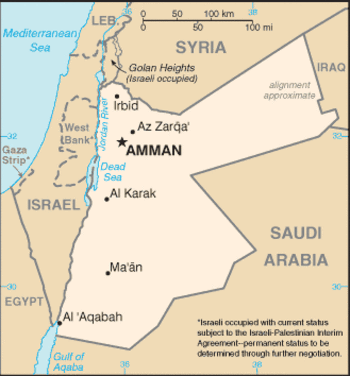 Above: The Hashemite Kingdom of Jordan
I have been in Amman, Jordan for a week now working on a project. Jordan is a peaceful country in the not so peaceful neighborhood of Israel, Egypt, Lebanon, Syria, Iraq and Saudi Arabia. The country is much more developed than I would have thought, though fully 30% of the population lives below poverty and there are over 1.75 million displaced Palestinian refugees. (1)
Yesterday I took a day long trip from Amman to Petra. Petra ("rock" in Greek) is considered the most famous archaeological site in Jordan. It is located 262 km south of Amman and 133 km north of the port city of Aqaba. Petra was first the capital of the Nabataeans and the center of their caravan trade around 2 BC. These first inhabitants of Petra appear in the Old Testament as the Kenites (or Cainites) of the tribe of Cain, the son of Adam (Gen. 4:21-22). References to Petra abound in Jewish, Christian and Islamic writings. (2) For example Aaron, the brother of Moses, is said to be buried on Jabal Harun above Petra.
Petra was later occupied by the Romans around A.D. 106 and subsequently by both Christians and Muslims. Most of the monuments in Petra are in fact tombs and temples for burials and ritual sacrifice. Petra is now a UNESCO World Heritage site. (3)
The approach to the fortified city is through a kilometer long, natural fissure in the sandstone that remains cool in the shade protected from the baking sun above.
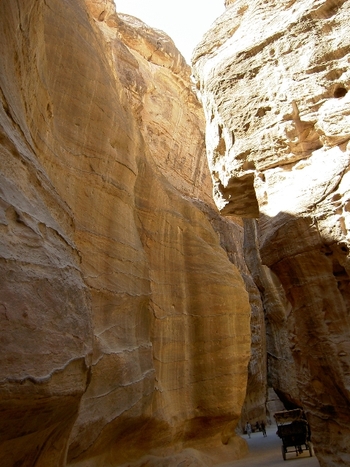 Above: The Siq (shaft), a natural split in sandstone rocks approaching the ancient city of Petra.
The Siq opens up on the most amazing temple in Petra, Al Khazneh (the Treasury) hewn by the Nabataeans directly out of a sandstone cliff over 2000 years ago.
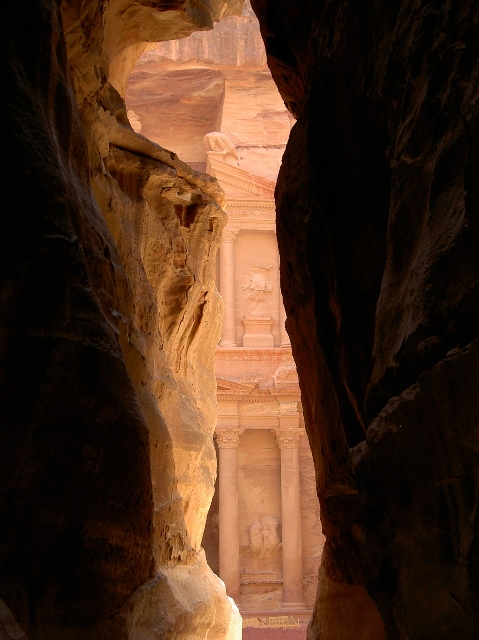 Above: The Treasury from the Siq
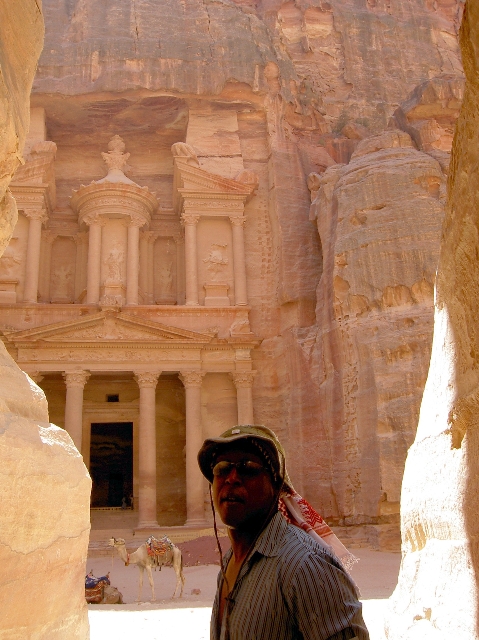 Above: Me approaching "the Treasury" from the Siq.
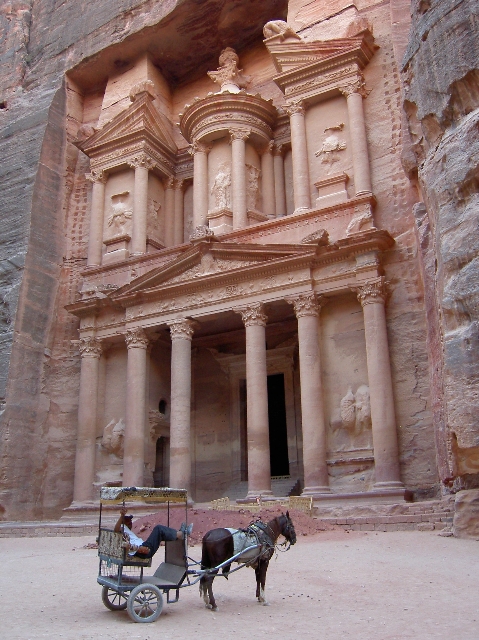 Above: The Treasury at Petra
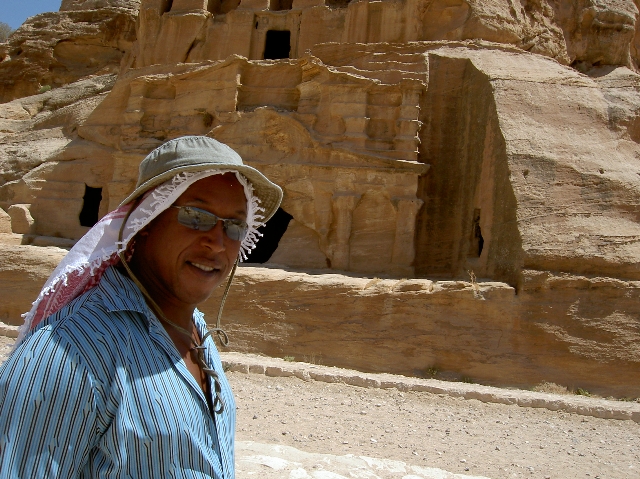 Above: Me in Petra
See all of my photos from Petra here.
Recovered from the Wayback Machine · originally at http://fredferg.blogs.com/travelog/2005/09/20050910_petra_1.html