Sentient Life on the Third Rock
2008-07-18 The Four Serious Issues Facing America: Healthcare Reform
Health care is one of those issues that brings out idealogical and philosophical stances in the American political dialog like no other. Whether or not you feel that access to quality health care is a basic human right that must be provided by all civilized countries there are a few basic facts about the American health care system that cannot be ignored. First and foremost, the American health care system is the most costly and inefficient in the world. It also has the lowest return on investment (ROI) when health care expenditure is measured as a function of average life expectancy. (Click on the graphs to enlarge.)
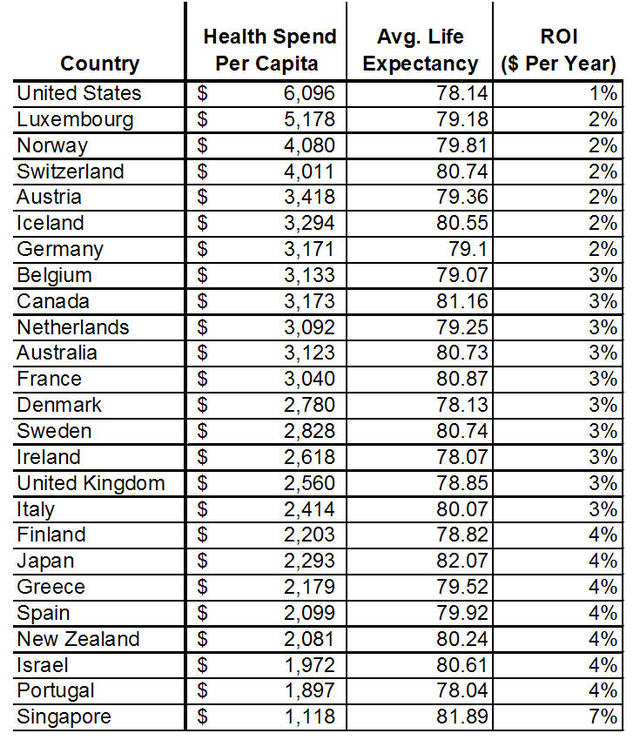
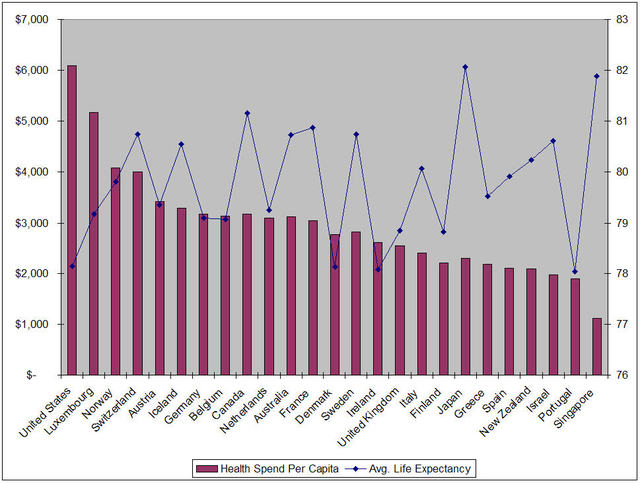
The health care expenditure statistics come from the United Nations Human Development Report, 2007. The average life expectancies come from the CIA World Factbook.
So what is the significance of runaway American health care costs? I guess there are two points. First of all, there is no reason to believe that the American health care system is underfunded. We don't need to spend any more money. In fact, I would suggest that with respect to the 40 million Americans currently uninsured it is arguable that the only way to bring them into the system is to reduce the cost of access to health care. Let me say that again. The reason we have so many uninsured in the United States is because we spend to much money on health care in the first place. This is easy to see. If I open a new private clinic no one who is currently uninsured will be able to afford to pay for my cost recovery and so I will go out of business. Why is health care in America so expensive then you may ask.
I remember seeing the following chart in the Economist that compared relative spending on information technology across different industries. The health care sector spends less money on automation and information technology than virtually any other segment of our economy.
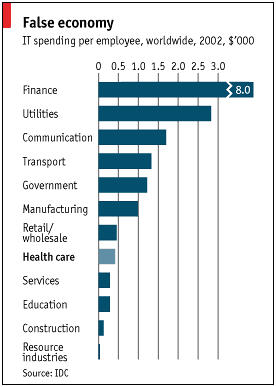
People fully expect that when they roam from state to state that their cellphone will continue to work and that they can go online and check the delivery status of their FedEx packages. And yet, there is no system in place to electronically transfer your medical records or prescriptions from physician to physician or pharmacy to pharmacy. And anyone waiting on the private sector to create its own information management and data transfer standards will be waiting a long time indeed.
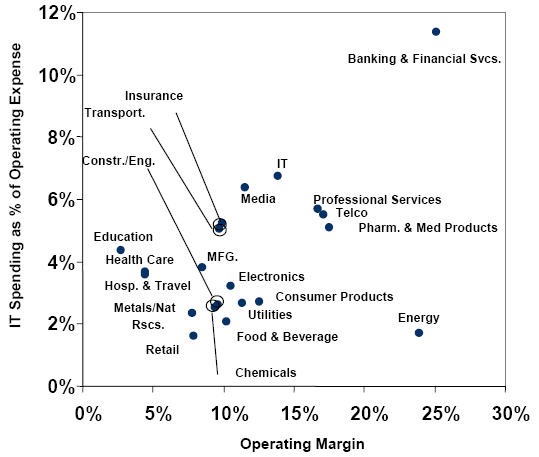
This graphic is from the Gartner Worldwide IT Benchmark Service New Trends & Findings for 2007. While there is not clear causality, sectors spending more on information technology as a percent of total operational expense are realizing higher operating profits. It appears that IT increases economic efficiency probably through greater process automation and leverage of existing employees.
Health care is a 3-way value chain with providers (i.e., physicians and hospitals), customers (i.e., patients) and payors (i.e., employers and insurance companies). All of these counterparties need standards to be defined for sharing financial data (e.g., bills and payments), patient data (e.g., medical records), provider data (e.g., capacity, utilization and pricing) as well as medical knowledge (e.g., drug indications, research trials, etc.) In the financial services sector there are numerous standards to facilitate financial transactions, settlements and risk management. In addition, heavy government accounting standards and regulations have given financial institutions greater tools to measure their own internal performance in order to better adjust to ever changing market conditions. We need greater information innovation in health care in order to reduce costs, improve efficiency and increase access. When will America wake up and bring the health care industry into the 21st century?
Recovered from the Wayback Machine · originally at http://fredferg.blogs.com/seething/2008/07/2008-07-18-the.html
1 comment
charlesclarknovels · 2008-07-19 10:05
Great information that supports my experience in health care for over a half-century. The key words that describes our fractured healthcare system are "most expensive/poorest outcome." Read SPEAKING OUT on my website.
Charles Clark
www.charlesclarknovels.com