Sentient Life on the Third Rock
2006-02-27 National Debt Mythologies
It now seems indisputable that the current Administration has lost all control of Federal spending. Of course that is what happens when one party controls the House, Senate and Oval Office and the President has failed to find a single piece of pork in 5 years worth vetoing. In their reckless pursuit of unfunded tax cuts and pork as alternatives to prudent economic policies, the Republicans have increased the Gross National Debt to an eye popping 8 TRILLION DOLLARS! Frequently, you will hear Bush apologists make vague claims that the economy has nonetheless grown faster than the crushing national debt. To put paid to this and other mythologies I have created the following chart with data from the White House [1].
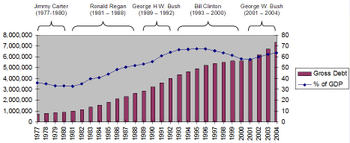 (Click on the chart above to enlarge.)
What this chart clearly shows is that whereas National Debt has continuously risen, without exception, every Republican administration since 1977 has increased the national debt as a percentage of GDP while every Democratic administration has reduced it. For me this is a moral issue. Borrowing from future generations to pay for the greed of the top 10% of Americans is both economically senseless and immoral. And there is no trickle down. Income inequality has increased dramatically recently even between the rich and those with college educations [2]. I challenge anyone who voted for the current bandwagon of greed, hate and fear to justify this.
Recovered from the Wayback Machine · originally at http://fredferg.blogs.com/seething/2006/02/2006-02-27-nati.html
6 comments
adam d millard · 2007-03-13 15:57
dude...fascinating...having trouble with the "Historical Tables, Budget of the United States Government, Fiscal Year 2006" link...can you check it...it's not working on my browser...x
Matthew Haavisto · 2007-03-13 15:57
It's even worse than you think. The whole percentage-of-GDP thing is a hoax anyway. (see my blog post on this: http://www.tapio.squarespace.com/journal/2006/1/23/a-debt-ridden-society.html)
GDP isn't really a measure of what we PRODUCE (as you might expect with the word Product in there). It's a measure of what we spend. So we spend much of what we borrow. Big deal. The wheels of industry grind on.
Frederick · 2007-03-13 15:58
Matthew,
I think the only valid way to measure an economy such as ours is expenditure (and not income). Building an apartment building has obviously increased national wealth even before a dime of rent is collected. And I do think it matters how this money is "spent". Education, preventive health care, infrastructure, national security (do not read this as foreign military interventionism) are much more reasonable than giving unfunded tax cuts to the top 10% of Americans.
Matthew Haavisto · 2007-03-13 15:58
Fred, Expepditure is not a valid measure of national economic health when so much of it is based on debt.
Let's say I were to take out as many loans and credit cards as the banks would allow me, buy a big house, a couple of new cars, and lots of goods and services. I'm spending much more than my income. I do this for years as my debt rises. Not knowing the details, you might look at my life and say Matthew is doing really well! Look how prosperous he is. In reality I'd be a pauper and either I'm eventually going to have to pay, or the people who lent me the money are left holding the bag (or my kids). My behavior doesn't present a true measure of my production or contributions to the economy.
The other thing that bothers me is that when the shit hits the fan, it hurts everyone, even those of us who are responsible with our money. When things get too bad the government historically has taken steps like monetizing the debt, which devalues the money we've saved.
Frederick · 2007-03-13 15:59
Matthew,
I don't understand your point. However in the example you describe, the borrower's debt is rising in lock step with their spending. In the case of America, the debts is rising even faster than spending. On the contrary, increased spending in the absence of a corresponding increase in debt assumes that income must have occurred. Please explain.
-Frederick
Matthew Haavisto · 2007-03-13 16:00
Actually, my analogy doesn't go far enough as your post illustrates. I was attempting to illustrate in a small way how the current problems inherent in deficit spending can be masked by the appearance of prosperity. In my example, my debt could rise faster than my borrowing too. Suppose I blew some of my borrowed money on gambling for example. Also, interest on the debt will make it rise faster than spending.
My main point, however, is that spending is not a good measure of health of a nation's economy, and that Gross Domestic PRODUCT should measure how much we PRODUCE (in all respects of goods and services). At an essential level, what you produce is what provides something of value that you have to trade with others. It's true that borrowed money can still contribute to the economy (building a house provides income to some and real value to the economy). But ultimately, it would be better for the economy if that person buying the house was paying for it with the value of what THEY produce, not just debt that is forever increasing.